Executive Summary Health, Safety and Risk Management
Palm Beach State College is committed to ensuring the health, safety, and security of all participants in its faculty-led international programs. Faculty leaders are expected to proactively research their travel destinations and collaborate with the Office of International Education (OIE) to prepare for potential emergencies and manage risks effectively.
Key health and safety protocols include:
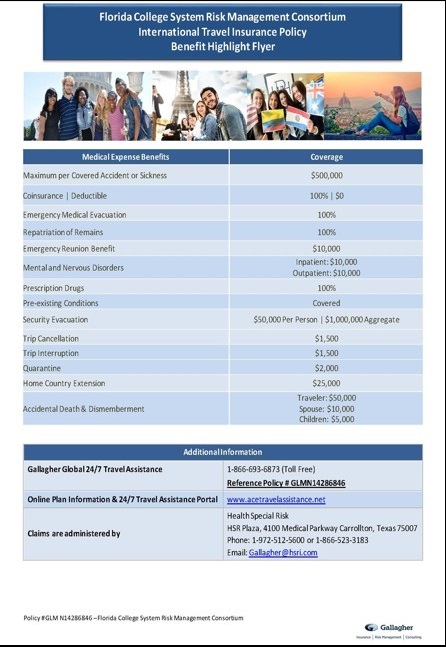
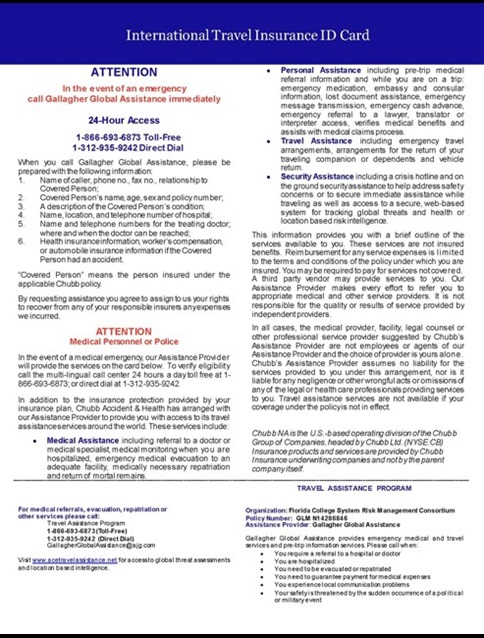
- Insurance: Both faculty and students are covered by comprehensive travel insurance, including emergency evacuation and repatriation.
- Emergency Action Plan (EAP): Faculty leaders must develop and communicate an EAP detailing crisis management procedure, including contact information for accommodations, embassies, and medical facilities.
- Pre-departure Registration: All program participants are required to register with the U.S. State Department’s Travel Registry (STEP).
In the event of an emergency, faculty leaders in coordination with their approved third-party provider, are responsible for:
- Prioritizing the safety of participants and contacting local authorities or medical professionals as needed.
- Immediately notify the OIE for guidance and support.
- Assisting students in contacting insurance providers and seeking medical care in the event of medical emergencies.
- Following local law enforcement procedures and keeping the OIE informed in non-medical emergencies.
- Consulting with the U.S. Embassy or Consulate in the case of ongoing political or health risks.
- Collaborating with the OIE to assess whether the program should continue during crises and coordinating evacuations if necessary.
Faculty leaders are also required to maintain student confidentiality during crises and are encouraged to reach out to the OIE with any concerns regarding emergency management. Through these protocols, Palm Beach State College aims to ensure a safe and supportive environment for all faculty-led program participants.
Download Instructions for the Traveleye Portal App and Resources
Download instructions for the TravelEye Portal App and Resources
Gallagher Travel Insurance
Health- Safety and Risk Management
At Palm Beach State College, the health, safety, and security of faculty-led program participants are of the utmost importance. The College ensures that faculty leaders are thoroughly prepared for potential emergencies and equipped to manage risks while abroad. Faculty members leading international programs are expected to proactively assess destination-specific risks, develop an emergency response plan, and adhere to established safety protocols.
Health and Medical Insurance Requirements
All faculty members and students participating in Faculty-Led Programs are provided with travel insurance that includes coverage for medical emergencies, evacuation, and repatriation of remains, in addition to other basic coverage. Faculty and students should ensure they understand the insurance coverage and carry relevant insurance documentation when traveling. The Office of International Education (OIE) will provide details to all participants before departure.
Safety Protocols and Emergency Procedures
Palm Beach State College has put several safety protocols in place to minimize the risks associated with international travel. These protocols ensure that faculty leaders are well-prepared to address emergency situations and protect the well-being of participants.
- Monitoring of International Events:
The approved third-party tour operator is responsible for monitoring global events, including geopolitical developments, health outbreaks, and natural disasters, that may affect the safety of faculty-led program participants. Any significant risks identified by the operator will be communicated to faculty leaders, who will then take appropriate precautions.
- Emergency Action Plan (EAP):
Faculty leaders are required to work with the Program Director of Education Abroad to develop and share an Emergency Action Plan (EAP) with the OIE and program participants. This plan is a comprehensive guide outlining procedures for dealing with various emergency scenarios. The plan should include essential contact information, such as:
- Local emergency services (police, fire, medical)
- Nearest hospital(s)
- Embassy or consulate details
- Program accommodation contact details
- Emergency contacts for faculty leaders, OIE, and in-country support staff
Faculty leaders must ensure this plan is accessible and regularly updated, and it should be provided to all students during pre-departure orientations.
- International-Ready Communication Tools:
Faculty leaders are required to carry an international-capable cell phone with them at all times during the program. This ensures they can quickly communicate with local authorities, the OIE, and other program staff in case of an emergency. Students should also be informed about emergency communication expectations, including the contact details of faculty leaders and emergency services.
- Travel Registration:
The U.S. Department of State’s Travel Registration (STEP) program allows travelers to register their travel plans with the U.S. government. It is required that both faculty and students register with STEP before departure to receive important safety updates and be accounted for in case of emergencies.
- Student and Faculty Orientation:
All students and faculty members must attend a pre-departure orientation session where safety protocols, emergency procedures, and risk management guidelines will be discussed.
Emergencies Abroad
Emergencies abroad can vary in severity, from minor issues to more serious situations. Faculty leaders should be prepared for a range of incidents, with a focus on keeping students safe and informed. While minor emergencies, such as lost passports or illnesses, are more common, it is important to also be aware of more serious situations that may require prompt action.
Types of Emergencies
- Minor Emergencies: These are relatively common and may include:
- Lost or stolen passports or credit cards
- Minor illness or injury
- Flight delays or cancellations
- Roommate or student conflicts
- Housing issues, such as overbooking or accommodation availability
- Group disagreements or disruptions
- Serious Emergencies: Though less common, these situations require immediate attention and may include:
- Physical assault or robbery
- Serious illnesses or injuries requiring medical attention
- Mental health crises or emotional challenges
- Legal issues, such as arrests or other legal actions
- Natural or man-made disasters (e.g., earthquakes, hurricanes, civil unrest)
- Significant accidents or injuries that need hospitalization
- More severe cases such as the death of a student or other critical incidents
Emergency Procedures and Faculty Leader Responsibilities
In the event of an emergency, faculty leaders have the Duty Awareness of the situation and ensure that the students are safe. The following steps outline the emergency response process:
- First Priority: Safeguard Students' Safety
Faculty leaders should immediately assess the situation and take action to ensure the safety of all students involved. In many cases, this will involve contacting local emergency services such as medical professionals, police, or fire departments. If the situation requires immediate medical attention, the faculty leader must ensure that the student receives appropriate care.
- Notification of OIE
The faculty leader must contact the OIE as soon as possible. The OIE will provide support, including liaising with local authorities, facilitating communication with parents or guardians, and offering guidance on next steps. Faculty leaders should provide timely updates on the situation to the OIE, who will help manage the crisis and coordinate any necessary responses.
- Medical Emergencies
In the event of a medical emergency, faculty leaders should assist students in contacting their medical insurance providers and ensure that the students are transported to the nearest medical facility if necessary. Faculty leaders should never leave students alone at a hospital or clinic without the express consent of the student. If hospitalization extends beyond the program’s end date, the decision for continued stay will be made by the approved third-party tour operator, in consultation with both the student and the faculty group lead, ensuring mutual agreement on the course of action.
- Non-Medical Emergencies
If the emergency is non-medical (e.g., robbery, assault, or civil unrest), faculty leaders should notify local authorities immediately and follow the required procedures. The faculty leader should continue to stay in close contact with the OIE and keep the students informed on the steps being taken.
- Political or Health Crises
In the event of a political or health crisis, such as civil unrest or an outbreak of disease, the U.S. State Department may issue travel warnings or public announcements. In such cases, the approved third-party tour operator, in coordination with the PBSC Office of International Education, will assess whether the program should continue or if changes to the itinerary are necessary. The third-party operator will also coordinate with the U.S. Embassy or Consulate for guidance and keep the faculty leader and students informed.
- Evacuation and Return
While evacuating students from a Faculty-Led program is a rare occurrence, if the situation escalates to a point where evacuation is necessary (such as an imminent threat or a natural disaster), the approved third-party tour operator, in coordination with Gallagher Global Insurance, will assist in facilitating the safe return of all students and faculty members. Faculty leaders will be responsible for ensuring the group’s safety during the evacuation process and must follow the guidance from Gallagher Global Insurance and the third-party tour operator regarding logistics and communications.
- Faculty Leader Communication with Emergency Contacts
Faculty leaders are authorized to share pertinent information with the emergency contact listed on the Study Abroad Application in the event of an emergency. This includes, but is not limited to, information regarding the student’s health condition, any injuries, medical treatments being administered, and the nature of the emergency or crisis. Sharing such details is crucial to ensure that the emergency contact is fully informed and able to provide necessary support, make informed decisions, or assist in facilitating any necessary actions. Faculty leaders must ensure that any disclosure is appropriate and made only to those with a legitimate need to know, following the guidance and protocols set by the OIE.
Conclusion
The health, safety, and well-being of students and faculty are the primary concerns during a Faculty-Led program abroad. Faculty leaders must be proactive in preparing for potential emergencies by creating an Emergency Action Plan, staying informed about their destination, and ensuring that all participants understand the health and safety protocols. In the event of an emergency, faculty leaders are expected to take swift action, maintain calm, and collaborate with the OIE to manage the situation effectively. Through careful planning and adherence to these guidelines, Palm Beach State College aims to provide a safe and enriching experience for all participants.